Showing posts with label Australia. Show all posts

Tuesday, September 24, 2013

Smartphone asthma device launched in Australia

0 comments
Medical technology firm iSonea has launched a device to help asthma sufferers monitor their condition with a smartphone.
The AirSonea device turns a phone into a portable wheeze monitor when held against the windpipe near the base of the throat.
Sounds are transmitted via the smartphone to a cloud-based site to be analysed with iSonea's acoustic respiratory monitoring technology.
The wheeze rate is then downloaded to the phone.
iSonea says the device enables asthmatics to monitor their wheeze anywhere, anytime, and provides data to help doctors with patient reviews.
Previously, devices called peak flow meters have been available for manual asthma monitoring, but iSonea says the meters require repeated forced breathing efforts that are hard for children and elderly patients.
Reporting of peak flow measurements have also proved unreliable.
iSonea chief executive Michael Thomas described the Australian launch of the AirSonea as a turning point for the company.
"Investors in our company are participating in the most exciting advancement in decades in respiratory mobile health technology," he said in a statement on Tuesday.
The AirSonea is expected to be launched in the United States in the first quarter of 2014.

Enhanced by Zemanta
Read more...

Sunday, June 16, 2013

Smartphone app turns tone deaf into music makers

0 comments
Even the most unmusical - or tone deaf - person can feel like an accomplished composer with the development of a groundbreaking app from Swedish company, Dorimer Music Research.
The smartphone app, ScoreCleaner Notes, is the brainchild of Sven Emtel, a sound engineer at Stockholm's Royal Institute of Technology, and Swedish folk musician, Sven Ahlbäck.
Bringing music and technology together
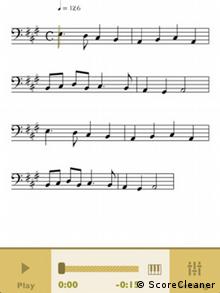
Some have called it a marriage of music and technology. The app let's users sing or whistle into their smartphone and have the tune come out perfectly pitched… that is, pitched corrected. All you have to do is make sure you whistle in single, monophonic tones. The app records your voice and turns the melody into a musical score.
The smartphone app records a user's voice and writes the score
Ahlbäck says the app "takes the sounds you sing and transforms them. It identifies pitches when you sing or even when you talk and then tries to analyze this."
Screenshot ScoreCleaner Notes App Smartphone 
It means that non-musicians can sing or hum a tune, have it corrected by the app, and then relay that "perfect music" to another person who can read the music and perform it. The app converts what it hears into notes and displays them on the smartphone screen, just as you would find in sheet music, says Ahlbäck.
"You could put the smartphone on a music stand and let someone else play it. I could send it to a friend in Australia or Japan and they could instantly perform it," says Ahlbäck.
The app uses cognitive technology – meaning, it detects and analyzes patterns in the sounds your produce, and it uses that data to eliminate any errors.


Source:Internet
Enhanced by Zemanta
Read more...

Wednesday, December 5, 2012

Stethoscope in Cloud using SmartPhone

0 comments


The StethoCloud app shows where on the body the 'stethomic' should be placedThe app works in conjunction with the 'stethomic' attachmentThe StethoCloud Smartphone AppThe leading cause of death in children worldwide, pneumonia kills an estimated 1.4 million children under the age of five every year - more than AIDS, malaria, and tuberculosis combined. Now, a team of scientists at the University of Melbourne, Australia has created “StethoCloud”, a cloud-based app for smartphones that can help diagnose conditions like pneumonia without the need for a doctor.

The StethoCloud app guides the user through the proper method for listening to a patient’s breathing when the “stethomic” attachment – a small microphone that plugs into the smartphone’s audio input – is placed on the patient's body. When the app has recorded enough information, the phone transmits it to a server to filter out noise and analyze the data. Once the server has examined this information, the results are sent back to the phone with recommendations for treatment.
Many of the deaths from pneumonia come from developing countries where stethoscopes (and the medical professionals needed to accurately diagnose the disease) are in short supply. Pneumonia-related symptoms often present as indications of other less harmful conditions, so people generally don’t seek immediate help. By the time pneumonia is diagnosed these symptoms have often reached a life-threating stage.
By eliminating the geographical problems associated with people receiving medical help, the StethoCloud can essentially be seen as a “portable doctor”.
The stethomic attachment is expected to cost only around US$20, which is several hundred dollars cheaper than digital stethoscopes on the market.
The StethoCloud website puts it this way: “It is now possible for people in the developing world to make their own devices based on our design. A local technician with access to sufficient training and the right materials can produce our digital stethoscopes thereby empowering communities to be self-reliant.”
Team StethoCloud, the group of young doctors and computer science majors that created the application and stethoscope attachment, first came to prominence in the 2012 Microsoft Imagine Cup technology competition.
The team is currently working with the Royal Children’s Hospital in Australia to develop research protocols for field-testing. The stethomic attachments have already been shipped to hospitals in Ghana, Malaysia and Mozambique.
Enhanced by Zemanta
Read more...

Thursday, December 17, 2009

Good IT Job sites

0 comments
Read more...
Related Posts Plugin for WordPress, Blogger...
 
IoT Vigyan © 2011 Main Blogger - Blogger Template & Blogging Stuff. Supported by PsPrint Emeryville and homeinbayarea.com