Showing posts with label Base Station. Show all posts

Thursday, February 9, 2012

Cloud RAN

0 comments

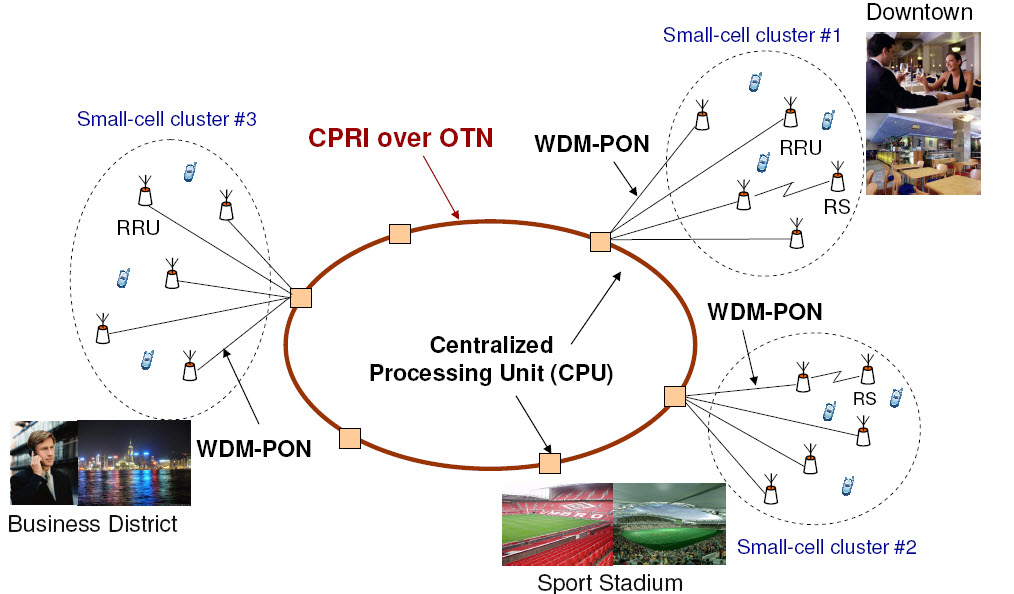
Distributed Node-B architecture called Cloud Radio Access Network (C-RAN) is the new paradigm in base stations architecture that aims to reduce the number of cell sites while increasing the base station deployment density bypassing some of the zoning and construction hurdles to brining up new sites on-air. Metro cities like NY, LA and SFO already have a high density of Cell towers. As LTE and more complex wireless technologies are being deployed – would it not make sense to re-use and harness the existing infrastructure?
The concept of the Cloud RAN comes with a new architecture that breaks down the base station into a Base Unit (BU) – a digital unit that implements the MAC PHY and AAS (Antenna Array System) functionality, and the Remote Radio Head (RRH) that obtains the digital (optical) signals, converts digital signals to analog, amplifies the power, and sends the actual transmission. By making the RRH an active unit capable of converting from analog to digital, operators can now place numerous BUs in a single geographical point while distributing the RRUs according to the RF plans. The RRH becomes an intelligent antenna array which not only submits RF signals but also handles the conversion between digital and modular data. New RRH can also support multiple cellular generation (2G, 3G and LTE) eliminating the need for multiple antennas.
The Cloud RAN lowers operating expenses and simplifies the deployment process. By centralizing all the active electronics of multiple cell sites, at one location (aka the “Base Station Server”), energy, real-estate and security costs are minimized. The RRH can be mounted outdoor or indoor – on poles, sides of buildings or anywhere a power and a broadband connection exist, making installation less costly and easier. The RRH is typically connected using fiber to the BU, creating cloud-like radio access network topology.  This topology saves costs both during the installation and later on technology upgrades for both software as well as hardware saving the operators millions of dollars in CAPEX/OPEX.
Enhanced by Zemanta
Read more...

Saturday, February 4, 2012

Self-Organising Network (SON)

0 comments
The logo of the NGMN Alliance The vision of self-organizing networks (SON), which is in line with the views of 3GPP (3rd Generation Partnership Project) and the NGMN (Next Generation Mobile Networks) group, is that future radio access networks needs to be easier to plan, configure, manage, optimize and heal compared to how it used to be.SON has been codified by the 3GPP Release 8 specifications in a series of standards including 36.902\ as well as public white papers outlining use cases from the NGMN.

The first technology making use of SON features will be UMTS Long Term Evolution. The LTE specification inherently supports SON features like Automatic Neighbor Relation (ANR) detection, which is the 3GPP LTE Rel. 8 flagship feature.
Newly added base stations should be self-configured in line with a ‘plug-and-play’ paradigm, while all operational base stations will regularly self-optimize parameters and algorithmic behavior in response to observed network performance and radio conditions. Furthermore, self-healing mechanisms can be triggered to temporarily compensate for a detected equipment outage, while awaiting a more permanent solution.
Enhanced by Zemanta
Read more...

Sunday, July 31, 2011

Radio Basestation on a single PCB

0 comments
Cambridge Consultants has launched what it claims is the smallest commercially available 2G and 3G small-cell basestation.
Called Sidewinder and aimed at mobile phone communications and professional radio, it is software configurable between GSM/GPRS/EDGE, WCDMA/HSPA+ and other software-defined radio applications.
03aug11Sidewinder.jpg
Sidewinder can operate at any carrier frequency from 375MHz to 4GHz and with a channel bandwidth from 200kHz to 28MHz.
"Available off the shelf, Sidewinder supports GSM link ranges up to and in excess of 40m indoors and 200m outdoors," said the firm. It can be provided either as hardware supplied directly from us, or as a reference design that can be manufactured by licensees."
On the front end there is a flexible radio device from Lime Microsystems, connected to Picochip PC312 femtocell baseband SoC.
It is compatible with Cambridge Consultants' Centaur GSM/EDGE PHY software reference and WCDMA software from Picochip.


Enhanced by Zemanta
Read more...

Wednesday, June 22, 2011

Heterogeneous Networks (HetNets)

0 comments
Heterogeneous Networks pdf

Heterogeneous networks are an attractive means of expanding mobile network capacity.A heterogeneous
network is typically composed of multiple radio access technologies, architectures, transmission solutions, and base stations of varying transmission power.
http://global.kyocera.com/prdct/telecom/office/lte/technologies/images/network.jpg


Enhancing and densifying the HSPA/LTE multi-standard macro-cellular network are additional methods of meeting increasing traffic demands and fulfilling users’ high expectations for mobile broadband services.
This article analyzes expansion strategies, covers important design choices for heterogeneous networks – focussing on transmission power differences – and explores how to cordinate low power nodes and macro base stations.


Enhanced by Zemanta
Read more...

Sunday, September 19, 2010

IP backhaul drive new sync solutions

0 comments
Changes in base station backhaul drive new sync solutions PDF


As more mobile network operators deploy high-speed data services using IP backhaul, the need for stable and accurate frequency reference becomes more critical. This need is particularly apparent for applications such as successful hand-offs between base stations and the transport of real-time services.
Enhanced by Zemanta
Read more...

Tuesday, December 22, 2009

UMTS Network Design & Cost

0 comments
UMTS Network Design & Cost pdf

A design exercise was carried out in order to assess the deployment cost of national UMTS networks in the 900 MHz, 1800 MHz and 2100 MHz bands. The design was carried out to provide voice & data coverage to 95% of the population and 80% of the geographic area of the Republic of Ireland. The number of base-station sites required for a 900 MHz network was found to be 533, 1013 for an 1800 MHz network and 1243 for a 2100MHz network.
Dimensioning was then carried out for an assumed subscriber profile giving a requirement for seven RNC’s to switch 4.28Gbps of traffic. The core network was then also dimensioned.
In estimating the cost of network deployment, the following network model was taken into account.

Detailed pricing was examined for turnkey rollout, the Radio Access Network (RAN), the core network, the service layer, mediation, provisioning, middleware & applications, network management and customer management.
All hardware pricing are estimates. Vendors do not publish pricing, and hardware costs are generally blended into turnkey packages including services and O&M. Vilicom has estimated pricing based on the projects on which it has worked internationally. The following costs were calculated based on recent network deployment costs for UMTS networks internationally.


Reblog this post [with Zemanta]
Read more...

Friday, November 28, 2008

Engineering for BSC (Base Station Controller)

0 comments
bsc-engineering pdf

The Engineering for BSC(Base Station Controller) provides describes some overall dimensioning rules
that should be considered when the BSC is purchased and plans for installation
are being made.
Read more...
Related Posts Plugin for WordPress, Blogger...
 
IoT Vigyan © 2011 Main Blogger - Blogger Template & Blogging Stuff. Supported by PsPrint Emeryville and homeinbayarea.com