Showing posts with label Radio access network. Show all posts

Thursday, February 9, 2012

Cloud RAN

0 comments

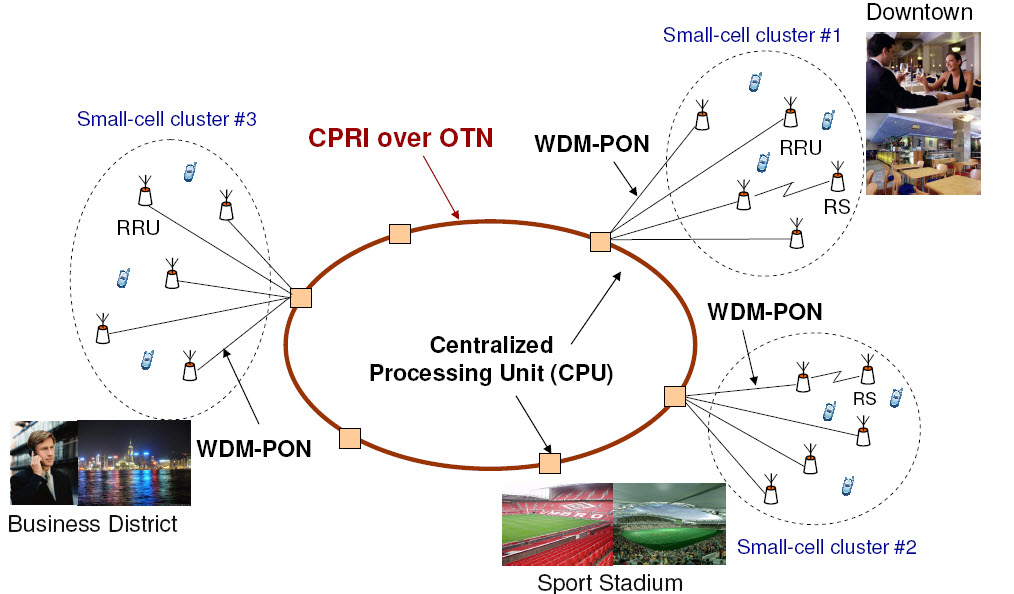
Distributed Node-B architecture called Cloud Radio Access Network (C-RAN) is the new paradigm in base stations architecture that aims to reduce the number of cell sites while increasing the base station deployment density bypassing some of the zoning and construction hurdles to brining up new sites on-air. Metro cities like NY, LA and SFO already have a high density of Cell towers. As LTE and more complex wireless technologies are being deployed – would it not make sense to re-use and harness the existing infrastructure?
The concept of the Cloud RAN comes with a new architecture that breaks down the base station into a Base Unit (BU) – a digital unit that implements the MAC PHY and AAS (Antenna Array System) functionality, and the Remote Radio Head (RRH) that obtains the digital (optical) signals, converts digital signals to analog, amplifies the power, and sends the actual transmission. By making the RRH an active unit capable of converting from analog to digital, operators can now place numerous BUs in a single geographical point while distributing the RRUs according to the RF plans. The RRH becomes an intelligent antenna array which not only submits RF signals but also handles the conversion between digital and modular data. New RRH can also support multiple cellular generation (2G, 3G and LTE) eliminating the need for multiple antennas.
The Cloud RAN lowers operating expenses and simplifies the deployment process. By centralizing all the active electronics of multiple cell sites, at one location (aka the “Base Station Server”), energy, real-estate and security costs are minimized. The RRH can be mounted outdoor or indoor – on poles, sides of buildings or anywhere a power and a broadband connection exist, making installation less costly and easier. The RRH is typically connected using fiber to the BU, creating cloud-like radio access network topology.  This topology saves costs both during the installation and later on technology upgrades for both software as well as hardware saving the operators millions of dollars in CAPEX/OPEX.
Enhanced by Zemanta
Read more...

Tuesday, December 22, 2009

UMTS Network Design & Cost

0 comments
UMTS Network Design & Cost pdf

A design exercise was carried out in order to assess the deployment cost of national UMTS networks in the 900 MHz, 1800 MHz and 2100 MHz bands. The design was carried out to provide voice & data coverage to 95% of the population and 80% of the geographic area of the Republic of Ireland. The number of base-station sites required for a 900 MHz network was found to be 533, 1013 for an 1800 MHz network and 1243 for a 2100MHz network.
Dimensioning was then carried out for an assumed subscriber profile giving a requirement for seven RNC’s to switch 4.28Gbps of traffic. The core network was then also dimensioned.
In estimating the cost of network deployment, the following network model was taken into account.

Detailed pricing was examined for turnkey rollout, the Radio Access Network (RAN), the core network, the service layer, mediation, provisioning, middleware & applications, network management and customer management.
All hardware pricing are estimates. Vendors do not publish pricing, and hardware costs are generally blended into turnkey packages including services and O&M. Vilicom has estimated pricing based on the projects on which it has worked internationally. The following costs were calculated based on recent network deployment costs for UMTS networks internationally.


Reblog this post [with Zemanta]
Read more...

Sunday, November 15, 2009

Understanding UMTS- Evolutionary Strategies

0 comments
Understanding UMTS- Evolutionary Strategies pdf

Release ’99 of the 3GPP specifications for UMTS are sufficient for operators to begin
to plan and deploy UMTS networks which consist of the brand new W-CDMA, FDDmode
air interface added to the standardised GSM Phase 2+ and GPRS core network. However the further evolution of UMTS will be strongly dependant on future standardisation work, in both 3GPP and in other relevant groups.
The speed of development and the eventual implementation of future specifications will also be immensely dependent on market demands and conditions, since these will determine the support and resources for such development.
Amongst the key broad areas in which ongoing specification and standardisation work is likely to impact the future of UMTS, are the following :
1. Upgrades to the core network, in particular beginning the move towards unifying and integrating the packet and circuit-switched domains, and providing the basis for multimedia services, on the basis of IP transport protocols.
2. Further development of service-related architectures, interfaces and procedures, including the continued evolution of CAMEL, USIM, security and fraud protection and the Open Services Architecture.
3. Further specification of the TDD mode of operation at the UMTS air interface. Since TDD spectrum is currently not applicable in Japan, TDD mode is not a priority for Japanese infrastructure and terminal vendors in the short term.
4. Investigation of possible commonalities and harmonisation of UMTS work in 3GPP with cdma2000 development in progress by 3GPP2. This is in line with the ITU concept of a family of 3G standards able to seamlessly interoperate easily. Other important and ongoing harmonisation efforts also include those between the GSM and US TDMA communities.
5. Although not strictly part of “UMTS”, specification of GERAN (GSM/EDGE Radio Access Network) is a development process which now falls under the auspices of 3GPP. EDGE is by no means certain of wide market acceptance and is not a requirement in implementing UMTS.
Although there is a body of opinion which supports the use of EDGE as a technology
to fill the coverage gaps between initial islands of UMTS, the existence of EDGE capable
handsets and complete GERAN specifications from 3GPP will lag behind the introduction of UMTS, and the first UMTS networks will therefore almost certainly still use GSM alone as the fill-in radio access technology.
Reblog this post [with Zemanta]
Read more...
Related Posts Plugin for WordPress, Blogger...
 
IoT Vigyan © 2011 Main Blogger - Blogger Template & Blogging Stuff. Supported by PsPrint Emeryville and homeinbayarea.com