Showing posts with label Samsung. Show all posts

Sunday, September 11, 2016

Loss of Goodwill or $1 Billion loss: Ban on Samsung Galaxy Note 7 from usage inside aircraft

0 comments

For the first time ever in India or any other country, a mobile phone has been banned from usage inside aircraft, because of it’s dangerous battery, which can explode any moment.

Samsung Galaxy Note 7, the latest offering from Samsung has been deemed as dangerous and explosive, just like a time-bomb. Such is the scare that The Directorate General of Civil Aviation (DGCA) has asked all airports to stop passengers from using the phone inside the plane.
And in case the passenger is carrying it in the check-in baggage, then the handset should be kept switched off.
In an order, DGCA said, “In light of the recent incidents involving battery incidents with Samsung about its Galaxy Note 7 devices globally, traveling public and airlines are advised not to switch on these mobiles during the flight or stow them in any checked in baggage,”
It’s not DGCA alone which has triggered such panic warning to protect aircrafts from getting exploded – official airline controls of half a dozen countries, including USA has issued such warnings.
US Federal Aviation Authority had issued similar orders few days back, notifying all passengers not to carry the defective Samsung Galaxy Note 7 handsets while travelling in aircrafts. Later on, Singapore Airlines, Qantas, Jetstar and Virgin Australia and Delta also issued similar warnings.
Interestingly, Korean Air, the official airlines of South Korea, where Samsung is headquartered, hasn’t issued any such warning. As per the officials, they have met Samsung officials, and they have been asked to allow to passengers to use Note 7 inside aircrafts.
But other airlines are not taking the risk, and have issued prior warning to safeguard all the passengers and the aircraft. Even Samsung and the U.S. Consumer Product Safety Commission have asked buyers not to use Note 7 handsets.

Recall Can Cost Samsung $1 billion; But Loss of Goodwill Is More Serious

Due to repeated incidents of batteries getting exploded, Samsung has already said that they will recall 2.5 million Note 7 handsets, all over the world. All customers will get new Note 7 handsets, and in India, due to the delay of shipment, Samsung is also giving a free VR Gear to compensate the delay.
However, this recall may cost Samsung over $1 billion in expenses, as per estimates from Bloomberg from Credit Suisse Group AG, Daishin Securities Co. and Pelham Smithers Associates
Although Samsung hasn’t yet officially acknowledged the expenses incurred for recalling over 2.5 million handsets, Koh Dong Jin, the head of Samsung’s smartphone business said that it was a ‘heartbreaking amount’.
As per available reports, 70% of the faulty batteries were supplied by Samsung, however, 30% of them were supplied by Amperex Technology, which is a company based in China.
Besides the financial losses, it’s the loss of goodwill and reputation which is being talked about most in this case. Airlines regulators banning the usage of a phone is a never-before-heard news, and the overall impression of Samsung has certainly taken a beating here.
Chang Sea Jin, a professor at the National University of Singapore, said, “The potential damage to reputation is far greater than short-term financial losses,”
clip_image001
clip_image002
*** Images Credit: Express.co.uk***

Source : trak.in
Read more...

Friday, July 19, 2013

'Kill switch' on smartphones takes a step forward

0 comments
Image representing iPhone as depicted in Crunc...
Image via CrunchBase
A call by federal prosecutors for phone manufacturers to install a "kill switch" to discourage smartphone theft has taken a step forward, with Apple and Samsung providing handsets whose security features will be put to the test.
As part of the "Secure Our Smartphones" initiative announced by U.S. prosecutors and other groups in June, phone makers are being asked to find technological solutions to prevent smartphone theft. U.S. law enforcement is dealing with growing crime -- including murder -- related to smartphone theft, especially iPhones, and one of the ideas put forward was the installation of kill switches to disable smartphones completely.

As part of the SOS initiative, Apple will provide an iPhone 5 with the "Activation Lock" enabled, while Samsung will provide a Galaxy S4 smartphone with the LoJack for Android feature. The smartphones will be tested for security features and "attempts will be made to circumvent the anti-theft features," said San Francisco District Attorney George Gascon and New York Attorney General Eric Schneiderman in a joint statement on Thursday.

The New York Attorney General's office did not immediately respond to requests for comment on when the results of the tests would be published.

The prosecutors expect smartphones with kill switches to be released by early 2014, and discussions about the initiative have been held with Apple, Google, Samsung and Microsoft. The SOS initiative is also backed by state officials, police chiefs, district attorneys, attorneys general and consumer advocacy groups.

Apple's "Activation Lock" feature in iOS 7 requires an iPhone owner to enter a username and password to enable a locked or wiped phone. The feature is intended to make it difficult to resell a lost or stolen iPhone.
However, Gascon in the past has said the Activation Lock feature doesn't go far enough to reduce smartphone theft. The feature isn't as good as a kill switch, which disables a smartphone completely and makes it useless, he has said.

During a press conference last month to announce SOS, Gascon also berated Apple for being uncooperative about bringing more stringent security features to the iPhone. However, Apple's chairman, Arthur Levinson, on the same day issued a statement saying that while the company shares the concerns about growing smartphone theft, it was being unfairly targeted as not cooperating to resolve the issue.

It is estimated that about 1.6 million people were victims of smartphone theft in the U.S. last year. Around 30% to 40% of all robberies are smartphone theft, according to the U.S. prosecutors.

Source:Internet
Enhanced by Zemanta
Read more...

Wednesday, May 29, 2013

Samsung Smartphones To Get Fingerprint Feature

0 comments
Samsung, fingerprint tech, access data, report, Sammobile, smartphone Though smartphone industry is carrying out various experiments in terms of screen size, RAM processor speeds, and even aesthetics, one area is yet to get its due: security.

Though there have been significant improvements in phone security mechanism recently, but most of them are based on old procedures such as PINs, patterns or no security procedure at all.
Now consider this. Your smartphone uses fingertip scanning in order to allow you access to the confidential data stored in it. Well, that’s what Samsung might be working on if a recent rumour is to be believed. 


Actually, the famous website SamMobile has received an e-mail today that displays a sequence of pictures showing off fingerprints and associated imagery. The images clearly indicate that Samsung is working on some kind of fingerprint technology for its upcoming phones. However, one should not forget that these images are the only ‘evidence' we have as of now, nothing more could be confirmed from the sources.

In case, Samsung comes up with a security system that involves using a fingerprint reader instead of the traditional home button, it would equip Samsung device owners with an essential security mechanism for data security.

It is also reported that Apple is also working on some sort of fingerprint tech for its iPhone 5S. Though fingertip scanning is not a new idea, but using it to for smartphones can surely help the handset owners.
 

 Source:Internet


Enhanced by Zemanta
Read more...

Tuesday, May 14, 2013

Samsung 5G development "several hundred times faster" than LTE

0 comments

The 5G millimeter-band transceiver has been developed by Samsung Electronics
LTE may only be wiping its feet on the proverbial doormat, and yet Samsung has already announced a significant breakthrough in the development of 5G mobile communications. The company says this will pave the way for next-generation mobile networks offering transmission speeds in the tens of gigabits per second – hundreds of times faster than LTE.
Samsung Electronics has developed an adaptive array transceiver capable of transmitting data at a rate of 1.056 Gbit/s at a range of up to 2 km (1.2 miles) in the tricky millimeter waveband. The millimeter band, or extremely high frequency band, is not normally associated with long-distance communications due to signal attenuation in the atmosphere and in rainfall.
At 28 GHz, Samsung's technology is operating just outside of the band normally considered the millimeter band, which ranges from 30 to 300 GHz. At these frequencies, electromagnetic radiation has wavelength of between 1 and 10 mm, hence the name. The millimeter band has long been recognized as offering the potential bandwidth to revolutionize telecommunications, with the broader range of frequencies available that would allow such high bandwidths at the commercial scale. The same principle applies here.
Samsung says that its 64-antennae transceiver, which transmitted data at 1.056 Gbit/s, "can be a viable solution for overcoming the radio propagation loss at millimeter-wave bands," and would allow the transmission of 3D films and games, ultra HD video and, intriguingly, "remote medical services."
The company predicts that 5G technologies may not be very far away, citing the European Commission's investment to commercialize them by 2020. 
source:Internet
Enhanced by Zemanta
Read more...

Monday, January 28, 2013

Refrigerators are getting smart using Android

0 comments
Refrigerators are getting smart. A new model released earlier this month runs apps to help users browse recipes, create shopping lists and manage the expiration dates of items like yogurt and milk.

The T9000 refrigerator by electronics company Samsung has a 10-inch Wi-Fi-enabled touchscreen and includes apps such as Epicurious for recipes and Evernote for note-taking.

"The fridge, because it's the hub of the family and the kitchen, is now another access point without having to drag around your tablet or have your phone with you in the vicinity of where you're cooking or entertaining," said Warner Doell, a vice president in the home appliance division at Samsung Canada.

The display enables users to keep up with the news, weather and even Twitter from the fridge door. It can also replace hand-written calendars with Google Calendar integration, and run slideshows of photos, according to Doell.

Shopping lists can be created on the fridge with the Evernote app, which will sync to smartphonesand recipes can be found at Epicurious.

Source:Internet
Enhanced by Zemanta
Read more...

Monday, January 14, 2013

A Look at Samsung's Curved Smartphone Concept and 4.99-Inch 1080p AMOLED Display

0 comments
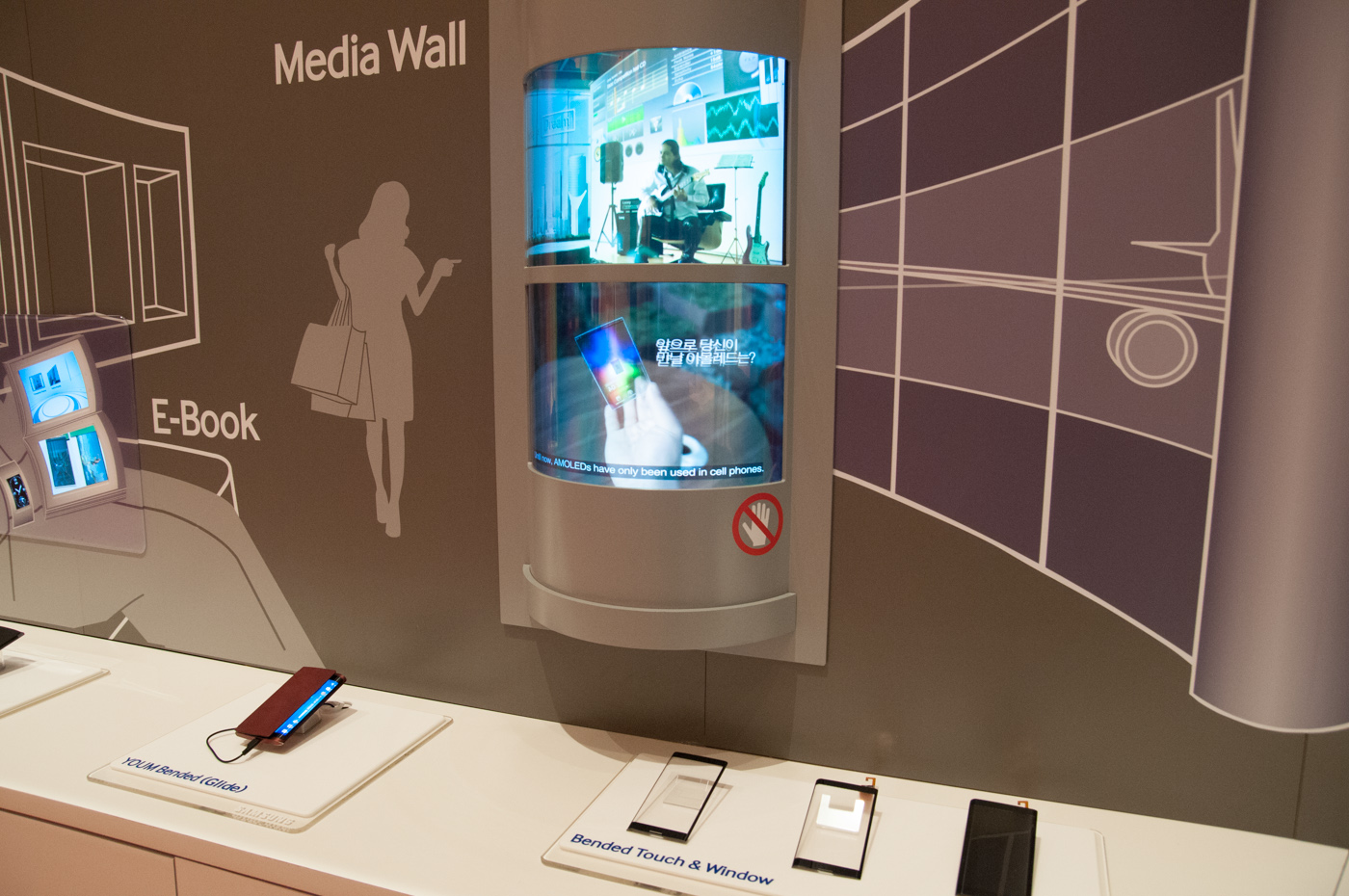
I got a chance to look at some of Samsung Displays' new and upcoming products, probably one of the highlights of my CES 2013 experience. There's a bit to go through, but first up are their buzzworthy curved displays and a concept phone or two. I spent three years in my undergrad optical and electrical engineering education working on curving a CCD for use matching focal planes, and thus curved displays are instantly near and dear to me as interesting next steps.
Samsung was showing off a single-axis curve in their demo room. First is a larger size display with a relatively small bend radius. It's a hemicylindrical display designed for signage.
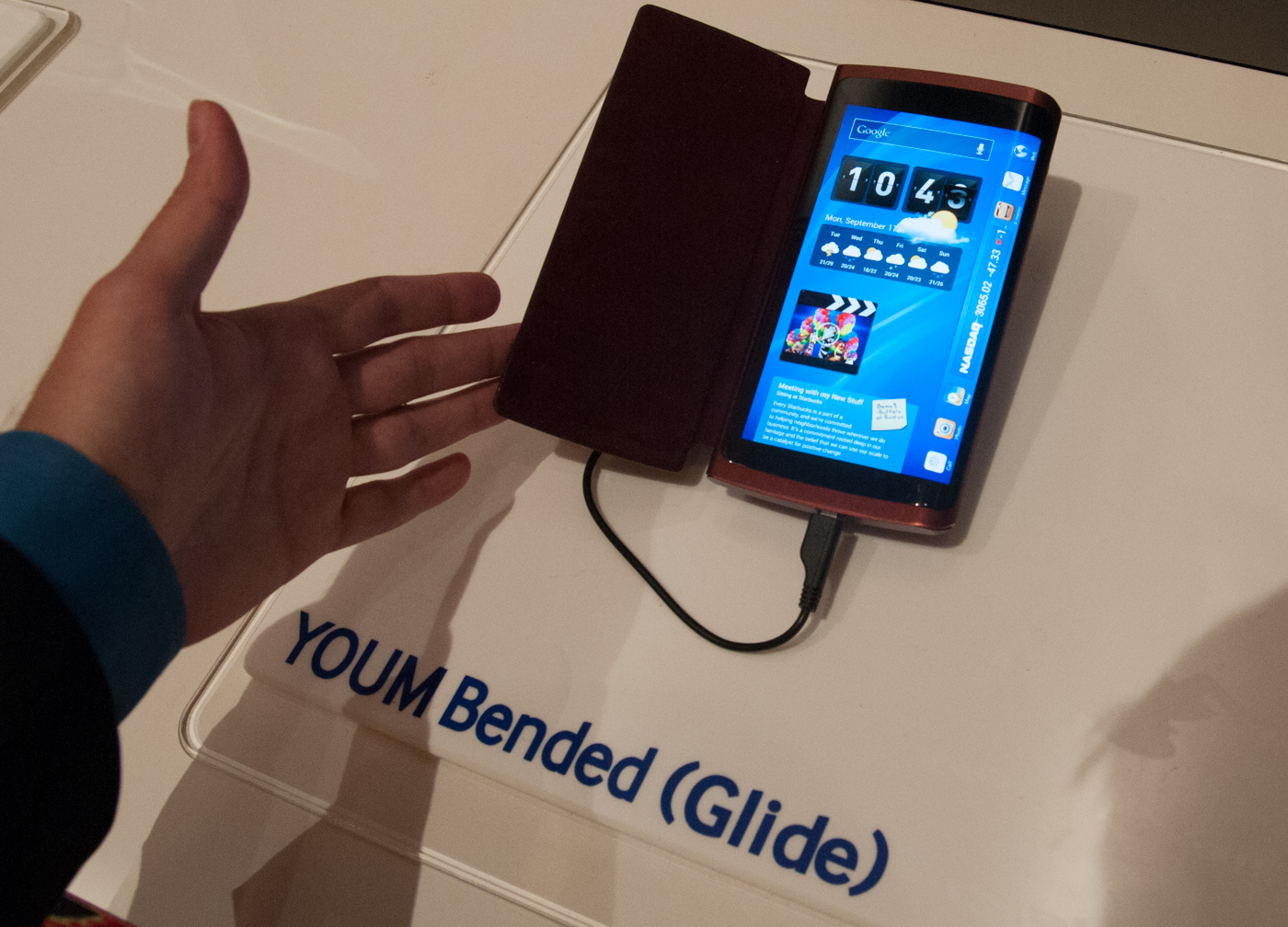
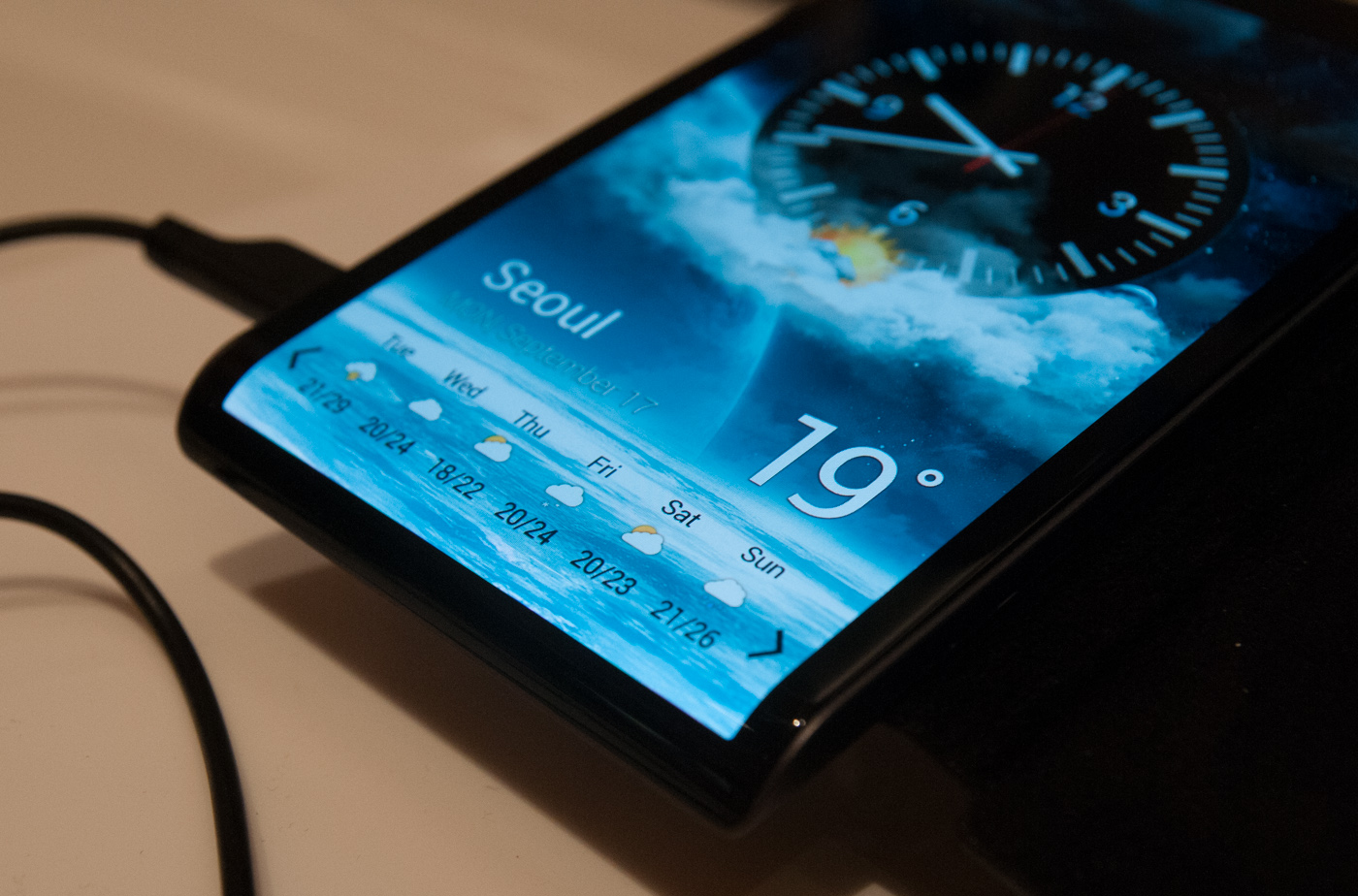
Next are two smartphone concepts. I've been wondering for some time what curved (not necessarily flexible) displays would enable or look like for a smartphone, and Samsung's concepts are actually pretty innovative looking. The two concepts have a bend on the horizontal or vertical axis — a bend on the right side, or bottom. Then a flip cover covers the planar section of the display while leaving the curved section exposed. This ostensibly allows glanceable information, notifications, and messages to be displayed without requiring a user to flip open the whole phone, and with AMOLED this section can be lit up without having to light up the entire display for saving some power.
The bend radius on these two isn't very extreme but looks like it could be a compelling example use case for a smartphone design. I don't expect either of these designs to come to market immediately, but it's clearly something on Samsung's mind for future products. The entire touch layer and display glass is curved with the display underneath.
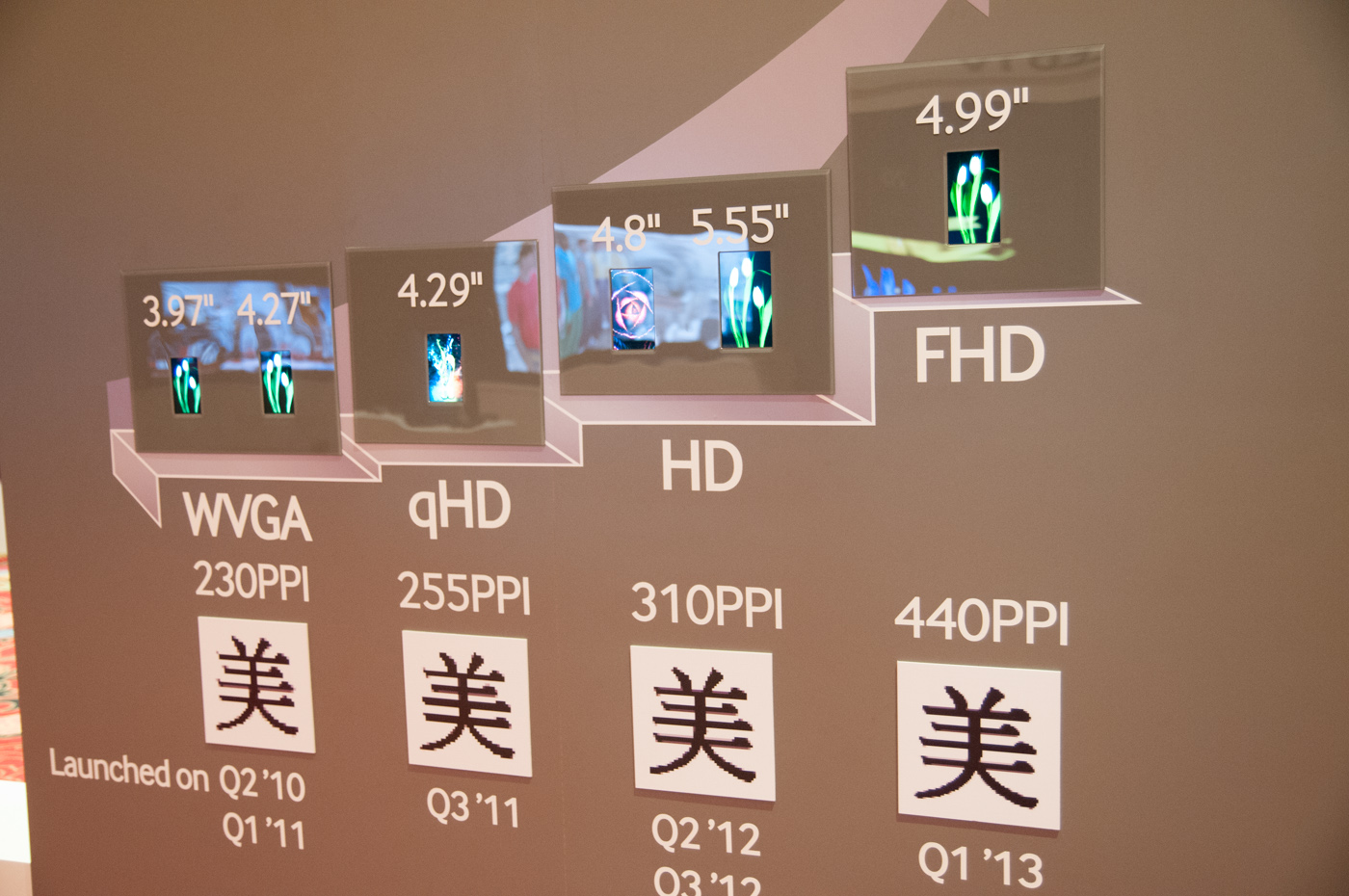
I'm burying the lead a bit, but I also caught a glimpse of what might possibly be the display headed to the next generation Samsung Galaxy smartphone. On display was an example roadmap of Samsung AMOLED displays, and at the far right slated for Q1 2013 launch is a Full HD 1080P display 4.99-inches diagonal with 440 PPI. I didn't get close enough to be able to see what the subpixel geometry or stripe was, but 440PPI underneath and the fact that it's the successor to the 5.55" display (from the Note 2) makes me think this is likely RGB.
Samsung is also claiming a 25 percent power saving using a new material on new AMOLED revisions, and also has a low power mode that I don't know much about with 47 percent power savings. Again, I strongly suspect this display will find its way into whatever Galaxy S 4 ends up being.

Source: Internet
Enhanced by Zemanta
Read more...

Sunday, January 13, 2013

Fulton Innovation launches eCoupled technology for bi-directional wireless charging (hands on)

0 comments

Fulton Innovation launches eCoupled technology for bidirectional wireless charging
Wireless charging is slowly creeping into more and more devices, and the convenience it brings is a welcome addition to our technological lives. But what if you don't have a charging pad nearby? With Fulton Innovation's eCoupled technology inside your device, you could use the charge in your tablet to charge your phone (or vice-versa). Essentially it enables the bi-directional movement of power between compatible devices. Any Qi enabled device can be charged by the eCoupled hosting device, and when two enabled devices are held back to back, then the one with the most power charges the other.

In the demonstration given to us on the show floor, Fulton Innovation had a reference device (a Samsung tablet) containing the technology, and demonstrated it by simply resting a Qi enabled mobile on top, and instantly it charged -- just like placing it on a regular charging mat. Fulton were also keen to stress their intention to get the technology incorporated into the Qi standard, meaning that if this were the case, then bi-directional charging like this could eventually be common place. Beyond the more obvious application of charging devices, there are other applications that this idea opens up. One such example is the use of "printed electronics" that can be activated simply by resting your phone or other enabled device on top. As a demonstration, a printed picture of a DJ with some speakers become an interactive soundboard once the eCoupled device was rested on the relevant point. This could also mean lightweight printed keyboard, that wouldn't require any charging, springing to life once you place your device on them. Check the gallery to see the idea in action, and the press releases over the break for more info.

Source:Internet
Enhanced by Zemanta
Read more...

Friday, August 10, 2012

Intel to try out wireless charging technology in ultrabooks and smartphones in 2013

0 comments
Intel may adopt its self-developed wireless charging technology into Intel-based ultrabooks and smartphones in the second half of 2013, according to sources from the upstream supply chain.
In addition to Intel, there are already several smartphone players and telecom carriers aggressively developing wireless charging technology. Japan-based NTT Docomo and Sharp both previously launched smartphones with wireless charging functions that meet the Wireless Power Consortium's (WPS) Qi standard, but high prices are still creating barriers that distance consumers, the sources noted.
Samsung was originally expected to launch a resonance wireless smartphone charger in June, but the project was delayed to the end of 2012 or into 2013 as performance still needs some improvements. Some market watchers expect Samsung will launch a magnetic induction wireless charger to fill the spot first.
Intel's wireless charging solution uses an ultrabook as the power source paired with related software and a transmitter to wirelessly charge a smartphone. According to Intel's data, the solution will feature lower power consumption and does not require the phone to be put in a very specific position.
Intel also provides design suggestions to integrate the transmitter and receiver together to lower production costs, and Intel has also designed software exclusively for power charging with functions such as power charging equipment examination, smartphone charging control, and equipment position tests all included.
Sources from notebook players also pointed out that Intel's Haswell platform is unlikely to fully adopt the wireless charging technology and the idea is expected be seen in just a few models in the second half of 2013.
Enhanced by Zemanta
Read more...

Saturday, July 28, 2012

Google Mobile Search Adds Handwriting for Easy Text Input

0 comments
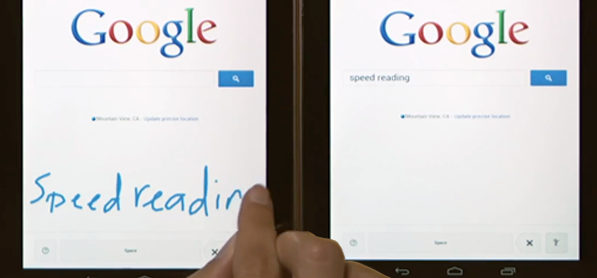
Google now lets you input a Google search query on your smartphone or tablet by writing it out with your finger, instead of making you tap it out on a keyboard or via voice command.
Called “Handwrite,” the timing is good for Google, considering when Windows 8 starts shipping in October it will have a similar function.
It’s a great addition to search, considering that pecking on a keyboard can be a pain and voice activated search often returns inaccurate results, especially when it comes to people’s names and other lesser-known proper nouns.

Handwrite is cool because after you turn it on in “settings” at the bottom of Google.com in your mobile browser, then refresh the page, you can write anywhere on your screen and your scratchings morph into typed letters in the search box.
It’s not perfect, by any means, and Google even calls it “experimental” and says it works better in some browsers—such as Chrome on Android devices—than others. Even within Chrome on my Samsung Galaxy Nexus I found it confused similar-looking letters such as lower-case “L” with “i.” Still, autocomplete results sometimes guess what you’re looking for even if Handwrite gets one or two letters wrong.
If you want to switch it off, or back on again, just tap a lower-case “g” icon on the bottom right of your screen. Handwrite currently works on iOS5+ devices, Android 2.3+ phones and Android 4.0+ tablets.
Enhanced by Zemanta
Read more...

Monday, February 27, 2012

Rumor: Samsung is working on a bezel-less Android smartphone

0 comments


Rumor: Samsung is working on a bezel-less Android smartphone
Just picture a smartphone without any of black borders around it. (Photo credit: Raymond Wong/DVICE)
With the way smartphone screens are getting sharper and larger, it's only a matter of time before those ugly black bezels that surround a screen disappear entirely. If any company can design a bezel-less smartphone, it's Samsung.
Samsung's no stranger to the make-gadgets-with-super-thin-bezels game. To get an idea of how committed Samsung is to removing excess gadget flab, one need only take a look at its high-end LED Smart TVs because those panels look ridiculous. Every single time I look at them at a Best Buy, it's like the picture is just floating midair.
If a report from Korea's MK News is to be believed, Samsung's taking its bezel-less expertise to work on an Android smartphone tentatively called "Samsung B." The report claims the smartphone has virtually no borders other than a small section at the top that houses the earpiece and a front camera.
Bezel-less smartphones would allow displays to be larger without having more mass. We'd basically be holding just the screen. But with that type of design comes fragility. If Samsung manages to use glass that's extremely tough like Corning's Gorilla Glass 2, then a bezel-less smartphone might survive a brush with the keys in your pocket.
Specs are extremely tightly wrapped right now, but it's possible that what MK News saw could be the Samsung Galaxy S III or possibly even a next-generation Nexus smartphone. The screen could also be a prototype for another company.
Almost all of last year, we heard about an edge-to-edge iPhone 5. Obviously, that device didn't materialize last year. Instead, Apple released the iPhone 4S with the same 3.5-inch Retina Display as the iPhone 4. As you probably already know, Samsung is an iPhone parts supplier. A bezel-less screen could just be an OEM part.
Enhanced by Zemanta
Read more...

Samsung announces Galaxy Beam smartphone with built-in projector

0 comments
When the name Samsung Galaxy Beam is mentioned, what comes to mind? If you were thinking about an Android smartphone with a built-in projector, then yes you would be right on the money! The device will sport an ultra-bright 15 lumens fully built-in projector that Samsung claims will allow for use even in outdoor environments, and if you’re the type that needs to make presentations on the go, then perhaps the Samsung Galaxy Beam might be a device worth your consideration.
The device will come with Android 2.3 Gingerbread preinstalled along with a 2,000mAh battery. Interestingly the Samsung Galaxy Beam measures 12.5mm thick, which while not exactly slim by today’s standards, is somewhat impressive given that it packs a full built-in projector. The projector will be able to project displays of up to 50” wide, and will come with an accompanying projector-dedicated app to allow for easy selection of content and projection.
As far as the rest of its hardware is concerned, the Samsung Galaxy Beam will sport a 4” 480×800 WVGA TFT display, with a 1GHz dual-core processor under its hood, 6GB of RAM and 8GB of internal storage that can be expanded by an additional 32GB via microSD card. It will also feature a 5MP rear-facing camera with built-in flash, a 1.3MP front-facing camera and will be able to record/playback videos in 720p HD quality at 30fps.
Unfortunately Samsung did not mention as to when the Galaxy Beam will be seeing a launch, nor how much it will cost, but check back with us as we’ll keep you updated!
Enhanced by Zemanta
Read more...

Tuesday, November 15, 2011

Samsung Galaxy Note :No ordinary smartphone

0 comments
IT'S QUITE common to hear words like ‘revolutionary’, ‘game-changer’ and ‘innovative’ thrown around during launch events in the mobile phone market, but the newly-released Samsung Galaxy Note was certainly the first device in a long time to come close to embodying those terms.
At the recent Galaxy Note world tour stopover in Jakarta, invited journalists had a first-hand look at the device and its capabilities. Right off the bat, the first major feature of the phone is its unusual size.
With a hefty 5.3-inch HD Super AMOLED screen, the Galaxy Note is billed as halfway between a smartphone and a tablet.
With a screen of that size, the Samsung Note allows users to browse the internet and read webpages comfortably, without scrolling. Above all, it functions as a sort of digital notepad, allowing people to jot down their thoughts or doodles.
Samsung Asia president and CEO Gregory Lee said at the launch: “For business users, they can easily open and read emails, check PDF files and make notes on the go, while for younger users, they can write down their stories and share their artwork among friends and family.
“This device gives a creative person the capability to capture and create anytime, anywhere. They can do all this in one mobile device. With this, Samsung is giving consumers a new smartphone user experience.”
In a presentation of the Galaxy Note, Samsung Indonesia mobile phone business director Budi Janto said: “All aspects of portability and functionality were considered. (The screen size) was best for people who wanted to bring their tablet around with them.”
Feel free to create
The Galaxy Note’s other major distinction is the S Pen, essentially a super stylus. While the device is still a touchscreen, the use of the S Pen takes its functions to another level.
Said Budi: “The pen still plays a vital role in our lives, and the S Pen is a bridge between the analogue and digital world.”
The S Pen simulates the workings of a normal pen, allowing for very accurate writing and drawing results. This was demonstrated in a display by Indonesian digital graphic illustrator Teddy Soegiarto, who sketched and coloured an image using the device.
“The S Pen allows users to use a series of apps, including S Memo, where users can take notes while surfing the internet,” Budi said.
“They can capture a screen image, make annotations on it, and send it via email. They can also crop out images and manipulate them any way they want, and even have fun by doodling on photos and videos and sharing them with others.”
Samsung has also been developing more apps that showcase the full capabilities of the S Pen, and an extended software development kit will be available in December.
The Galaxy Note has a super-fast 1.4GHz dual-core processor, runs on the Android 2.3 platform, has an 8MP camera with flash and a choice of 16GB and 32GB internal memory, and can support up to an additional 32GB.
It comes in two colours, dark blue and white, and retails at the recommended retail price of RM2,299. It will also be available through subscription packages under Celcom and DiGi.
New directions
The Galaxy Note also has added mobile security features, thanks to a partnership with Juniper Networks.
According to Samsung Asia mobile phone product manager Luke Lee, “The partnership gives a secure link from corporate to personal data, which is stored on (external) servers. Should anything happen to the phone, users can remotely access the servers and wipe out the information on the phone to protect it.”
While the notion of a phone with a larger screen size and use of a stylus is not new, Samsung is confident that the Galaxy Note is a trailblazer.
According to president and CEO Lee: “The ideas may have been done before, but our research has allowed us to create a device where the users’ needs have been satisfied. The size of the phone works really well, especially when combined with our Super AMOLED screen.”
Asked whether they are concerned that the release of the smartphone-tablet hybrid Galaxy Note would affect sales of the Galaxy S II smartphone or the Galaxy Tab 10.1, Lee said: “When you design new devices, you cannot be afraid to try something new. Also, we’re actually creating a new market segment with this device.”
With a series of roadshows planned to give consumers a hands-on feel of the Galaxy Note, Samsung executives are confident that the public will be attracted to the device, and all its capabilities.
But the Galaxy Note is not Samsung’s only tempting offering. At the launch, guests were also given a first look at the upcoming Galaxy Nexus, another highly-anticipated device that almost stole the thunder from the Galaxy Note.
And no wonder, as it comes equipped with the juicy Android 4.0 Ice Cream Sandwich platform, and with fun, people-friendly features that include allowing users to unlock the phone by smiling at it; to share photos, video and information just by touching it to another device; and to take panoramic, HD videos and photos.
With these devices, it’s clear that Samsung is playing to win in its premium mobile devices segment. Consumers will just have to wait to see what else Samsung has up its sleeves.
Enhanced by Zemanta
Read more...
Related Posts Plugin for WordPress, Blogger...
 
IoT Vigyan © 2011 Main Blogger - Blogger Template & Blogging Stuff. Supported by PsPrint Emeryville and homeinbayarea.com