
Illustration: Arokia Nathan
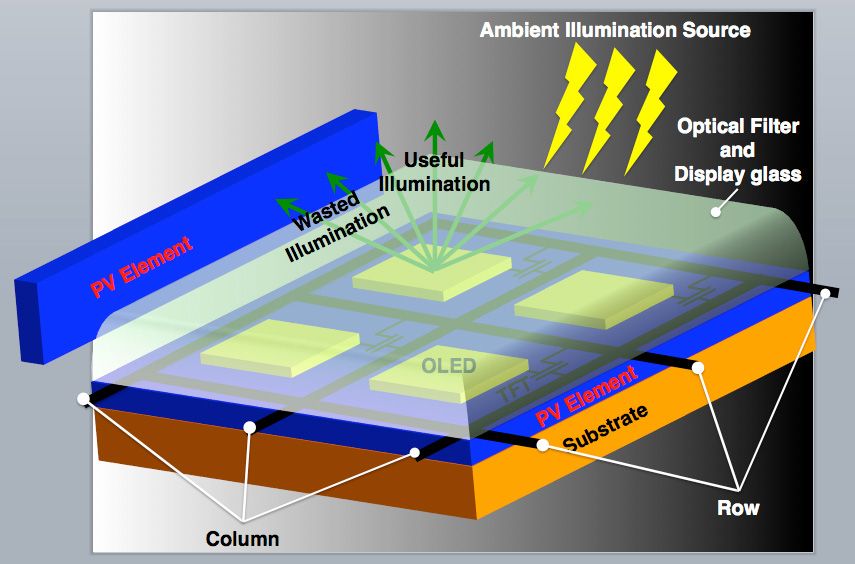
Energy Harvester: A thin-film system harvests energy from wasted light in an OLED display. Click on the image for the full illustration view.
Making the device work required sidestepping another problem: fluctuations in the voltage provided by the solar cell, which could have damaged the phone’s battery. The researchers, who were based at University College London until recently, designed a thin-film transistor circuit to smooth out voltage spikes and extract electricity more efficiently.
And instead of charging the battery directly, which would have involved adding complex circuitry, they worked with the energy group at Cambridge's Centre for Advanced Photonics and Electronics to integrate a thin-film supercapacitor for intermediate energy storage. This combination of photovoltaics, transistors, and supercapacitor yielded a system with an average efficiency of 11 percent and peak efficiency of 18 percent. If the PV array converts 5 percent of ambient light to electricity, the energy-harvesting system can generate as much as 165 microwatts per square centimeter under the right lighting conditions. For a typical 3.7-inch smartphone screen, that equates to a maximum power output of 5 milliwatts, "which is quite useful power," says Ahnood, though that’s only a fraction of a smartphone’s power needs.
There are existing CMOS-based switch mode voltage regulators that offer higher efficiency, says Ahnood, but they aren’t compatible with the thin-film technology used in smartphone displays. Furthermore, the team’s thin-film devices can be fabricated at temperatures below 150 °C on lightweight plastic, making them much more attractive for use in mobile phones, where every gram and every penny is a big deal.
The cellular handset prototype is just one example of such small-scale wireless energy harvesting. Another plug-free power source might be magnetic resonance coupling via an induction coil. Alternating current is run through a coil of conductive material, generating an oscillating magnetic field. That field, in turn, generates a current in a coil embedded in, say, a phone or an MP3 player.
Jun Yu, a doctoral student of Nathan's, reported preliminary work along those lines at the MRS meeting. He told scientists that the team had designed a flat thin-film coil that could be used as a receiver in a display. But the team doesn’t foresee the coil producing enough power to run an entire computer. It should, however, be possible to scale down the magnetic coupling scheme for use in mobile devices.
It will take quite a bit more research to get from prototype to consumer product. For example, the team is exploring different circuit designs and materials with the aim of increasing the energy harvesting system’s efficiency. Other energy scavenging schemes, such as MEMS-based kinetic energy harvesting, could contribute to further improvements, says Nathan.

 Facebook


0 comments:
Post a Comment